Sump Pump Installation and Replacement Cost NJ 2026: Protecting Monmouth County Basements from Spring Rain

Fence Installation Cost NJ 2026: Wood, Vinyl, and Aluminum Pricing for Monmouth County Properties
April 8, 2026
Kitchen Cabinet Refacing vs. Full Replacement Cost NJ 2026
April 22, 2026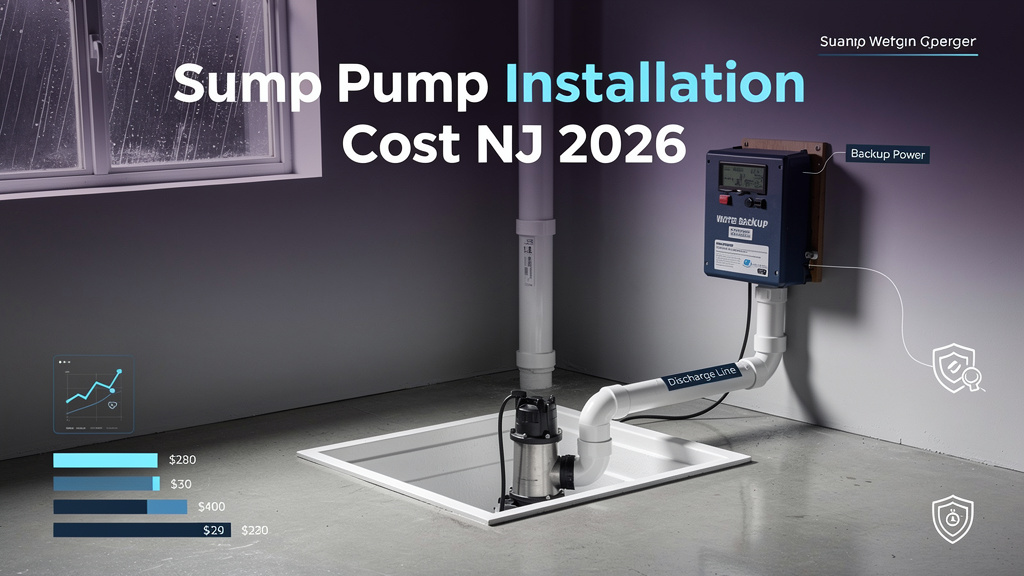
Installing a new sump pump in New Jersey costs between $1,200 and $3,000 on average in 2026, with basic pedestal pumps starting at $800–$1,500 and full submersible installations with battery backup running $1,500–$3,500. Replacing an existing sump pump costs considerably less — $309 to $754 on average.
Spring rain in Monmouth County is the No. 1 cause of basement flooding. After a winter of snowmelt, the water table rises, and without a functioning sump pump, that groundwater has nowhere to go but through your basement walls and floor. If your pump is 7+ years old or you’ve never tested it, April is the month to check before the heavy spring storms hit.
Key Takeaways
- Sump pump installation in NJ averages $1,200, with a range of $1,200–$3,000 for a full submersible install.
- Sump pump replacement (existing pit) costs $309–$754 on average.
- Pedestal pump installation runs $800–$1,500; submersible runs $1,000–$3,000.
- Battery backup systems add $1,000–$2,000 — critical for power outages during storms.
- Water-powered backup pumps run $1,200–$2,500 installed — no electricity needed, runs on municipal water pressure.
Sump Pump Cost by Type
| Pump Type | Installed Cost | How It Works | Best For |
|---|---|---|---|
| Pedestal | $800–$1,500 | Motor sits above the pit, visible | Budget installs, shallow pits |
| Submersible | $1,000–$3,000 | Motor sealed inside the pit, quiet | Most homes, quieter operation |
| Battery backup (add-on) | $1,000–$2,000 | Battery-powered secondary pump | Storm backup during power outages |
| Water-powered backup | $1,200–$2,500 | Uses municipal water pressure to pump | Homes on municipal water, no electricity |
| Combination (primary + backup) | $1,500–$3,500 | Dual-pump system in one pit | Maximum protection, flood-prone areas |
| Crawl space specialty | $1,200–$2,500 | Compact unit for low-clearance spaces | Crawl spaces, tight pits |
Sump Pump Replacement vs. New Installation
Replacing an existing sump pump is significantly cheaper than a first-time installation because the pit, discharge line, and electrical connection already exist.
| Scenario | Average Cost | What’s Included |
|---|---|---|
| Pump-only replacement (existing pit) | $309–$754 | New pump, check valve, basic testing |
| Pump + battery backup add-on | $1,000–$2,000 | New primary pump, battery backup unit, wiring |
| First-time installation (new pit) | $1,200–$3,000 | Pit excavation, liner, pump, discharge line, electrical |
| Full combination system install | $1,500–$3,500 | Primary pump, battery backup, pit, discharge, electrical |
The wide range reflects whether your basement already has a sump pit, whether the discharge line runs to daylight or needs a check valve and exterior run, and whether new electrical work is needed.
What Drives Sump Pump Costs Up?
New pit excavation. If your basement doesn’t have a sump pit, the contractor needs to cut a hole in the concrete floor, excavate a 18–24 inch diameter pit below the floor level, install a liner, and pour a new concrete collar. This adds $500–$1,500 to the project.
Discharge line routing. The discharge pipe needs to carry water at least 10–20 feet away from your foundation. If the nearest suitable discharge point is far from the pump, expect $200–$800 in additional pipe and labor costs.
Electrical work. A submersible sump pump needs a dedicated GFCI-protected outlet near the pit. If one doesn’t exist, an electrician needs to run a new circuit, adding $200–$600.
Battery backup complexity. A battery backup system adds $1,000–$2,000 including the backup pump unit, battery, charger, and float switch. The battery typically lasts 3–5 years and costs $150–$250 to replace.
Permit. Some Monmouth County municipalities require a plumbing permit for sump pump installation, especially if it involves a new discharge line to the exterior. Permit fees run $50–$200.
When to Replace Your Sump Pump Before It Fails
A sump pump that fails during a storm is the most expensive kind of failure because the water damage it was supposed to prevent costs thousands more than the pump itself. Replace your pump if:
- It’s 7–10 years old. Sump pumps have a design life of 7–10 years for continuous use. Past that, motor wear and impeller degradation mean failure is a matter of when, not if.
- It runs constantly during wet periods. A pump that cycles on and off every few minutes during normal rain is either undersized or the float switch is failing.
- It’s unusually loud. Grinding, rattling, or high-pitched whining sounds indicate bearing wear or a damaged impeller.
- It doesn’t turn off after the water is gone. A stuck float switch means the pump will either run dry (burning out the motor) or not turn on at all when water rises.
- You’ve never tested it. Pour a bucket of water into the pit. If the pump doesn’t activate within a few seconds, it’s time for a replacement or at minimum a thorough inspection.
Battery Backup: Worth the Extra Cost?
In Monmouth County, where spring storms regularly knock out power, a battery backup sump pump is one of the best insurance policies a homeowner can buy. The primary pump runs on household electricity — when the power goes out, the primary pump stops. The battery backup kicks in automatically and keeps pumping until either the power returns or the battery dies (typically 6–12 hours of continuous pumping).
For $1,000–$2,000, a battery backup protects against the single most common cause of basement flooding: a functioning pump rendered useless by a power outage during a thunderstorm.
If you’re on municipal water, a water-powered backup pump is an alternative that needs no electricity — it uses your home’s water pressure to create a vacuum that lifts water from the sump pit. It costs $1,200–$2,500 installed and uses roughly 1 gallon of municipal water to pump 2 gallons of sump water.
How Trusty Monmouth County Handyman Can Help
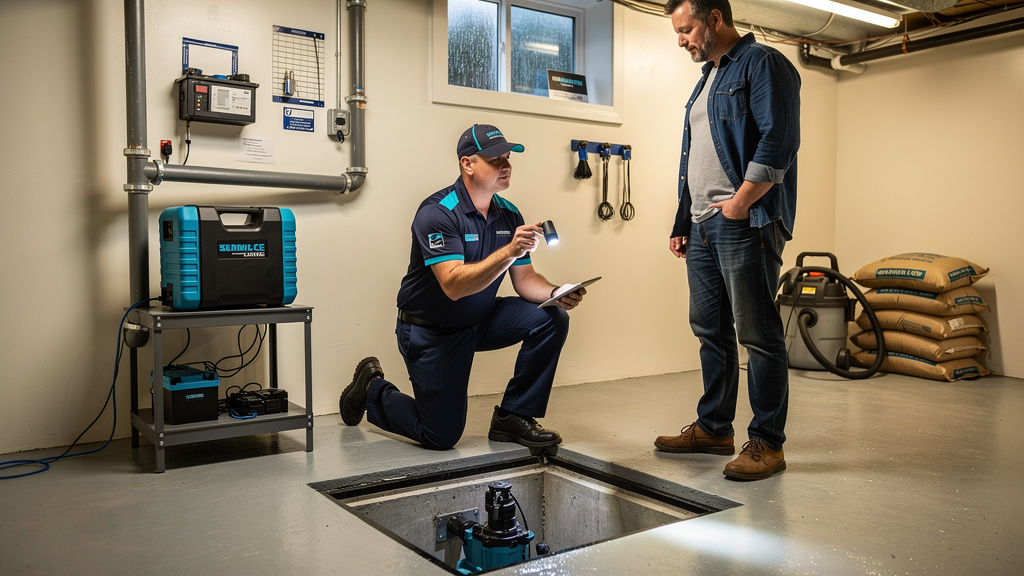
Sump pump installation involves plumbing work for the discharge line, electrical work for the pump circuit, and potentially concrete cutting for a new pit. At The Trusty Monmouth County Handyman, we handle the full scope — from pit excavation and pump installation to discharge routing and battery backup setup.
We’re fully licensed and insured, with 25+ years of experience, and we offer free estimates on projects over $200. Call (848) 272-9900 before the next storm hits.
Frequently Asked Questions
1. How much does sump pump installation cost in New Jersey?
Sump pump installation in NJ averages $1,200, with a range of $1,200–$3,000 for a full submersible install with pit and discharge line.
2. How much does sump pump replacement cost?
Replacing an existing sump pump costs $309–$754 on average, depending on pump type and whether a battery backup is added.
3. Do I need a battery backup sump pump?
In Monmouth County, where spring storms regularly cause power outages, a battery backup is strongly recommended. It costs $1,000–$2,000 and protects against the most common cause of basement flooding.
4. How long does a sump pump last?
Most sump pumps last 7–10 years with regular use. Pumps that run frequently during wet seasons may need replacement on the earlier end of that range.
5. How often should I test my sump pump?
Test your sump pump every 3–4 months by pouring a bucket of water into the pit. It should activate within seconds and fully empty the pit before shutting off.