How to Insulate Your Attic: DIY Tips vs. Hiring a Pro in Monmouth County

Smart Home Wiring and Automation Cost NJ 2026
April 29, 2026
Skylight Buyer’s Guide NJ 2026: Fixed, Vented, and Solar-Powered Options for Monmouth County Homes
May 11, 2026
Key Takeaways
- Monmouth County homes need attic insulation between R-49 and R-60, according to Department of Energy climate zone maps.
- Blown-in cellulose or fiberglass costs $1.50–$3.50 per square foot installed. DIY batt insulation runs roughly $0.50–$1.50 per square foot for materials only.
- Adding insulation to an older attic can cut heating and cooling bills by 15% or more. Savings depend on current levels and air sealing.
- Professionals bring blower machines, moisture gauges, and baffle vents that most homeowners do not own.
- Skipping air sealing before insulating traps moisture and wastes money.
Insulating an attic in Monmouth County means hitting R-49 to R-60. That is the Department of Energy’s target for New Jersey’s climate zone. Most older homes in West Long Branch and the surrounding towns fall short. A thin layer of existing batting or settled loose-fill often sits at R-19 or less. The good news: you can fix it yourself or hire a pro. The right choice depends on your budget and your roof layout. Whether you can spot problems like damp rafters or blocked soffit vents.
What R-Value Means for Your Attic
An R-value measures how well insulation resists heat flow. The higher the number, the better the barrier. The Department of Energy places Monmouth County in climate zone 4, with some inland pockets edging into zone 5. For an uninsulated attic, that means aiming for R-49 to R-60. If you already have 3–4 inches of insulation, you should add enough to reach at least R-38 and ideally R-49.
Most homes built before 1990 in Monmouth County have fiberglass batts rated around R-19. That was standard code at the time. It is not enough today. Heat rises straight through that layer in winter. In summer, your attic can hit 140°F and radiate downward, forcing your air conditioner to run longer. Think of R-value as the thickness of your thermal blanket. A winter coat beats a windbreaker.
How to Check What You Have Now
Turn off the power to an upstairs outlet. Remove the cover plate and shine a flashlight into the gap around the box. You should see insulation in the wall. But walls are not attics. For the attic itself, pull up the access hatch and measure the depth with a ruler or tape measure.
If the material looks like gray cotton, it is probably cellulose. Fluffy pink or yellow material is fiberglass. Rigid boards are foam. Note the depth in inches. The Department of Energy provides a chart to convert depth to R-value based on material type. Do not guess. Settled loose-fill compresses over time, so the depth you see may overstate the actual R-value.
Look for stains on the rafters or damp spots near the chimney. Those are signs of air leaks or roof venting problems. Insulating over wet wood traps moisture and invites mold. Fix the leak first.
The Main Types of Attic Insulation
Fiberglass Batts
A fiberglass batt is a pre-cut blanket of glass fibers. It fits between standard joist spacing, usually 16 or 24 inches on center. Batts are the most common DIY choice. You can buy them at any hardware store and roll them out yourself. The downside: batts leave gaps around pipes, wires, and irregular framing. Those gaps let air bypass the insulation. In Monmouth County’s humid summers, that air carries moisture.
Blown-In Cellulose and Fiberglass
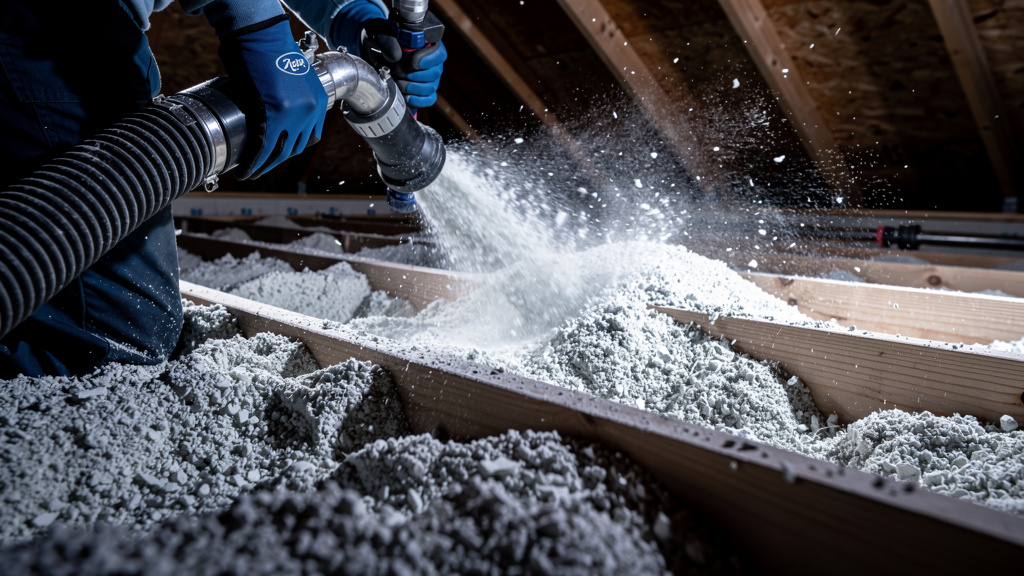
Blown-in insulation is loose material sprayed through a hose. Cellulose is ground paper treated with borate fire retardant. Fiberglass loose-fill is spun glass. Both fill corners and crevices better than batts. A professional crew can blow a 1,500-square-foot attic to R-49 in a few hours. The material also acts as a mild air barrier because it packs tightly.
Cellulose has slightly better R-value per inch, about R-3.2 to R-3.8, compared to loose-fill fiberglass at R-2.2 to R-2.7. That matters when your rafter height is limited. The Department of Energy notes that blown-in products settle, so installers must account for compression when calculating final depth.
Spray Foam
Spray polyurethane foam expands on contact and seals air leaks at the same time. Closed-cell foam reaches R-6 to R-7 per inch, the highest of any common material. It is also the most expensive, often $3 to $7 per square foot. Most Monmouth County homeowners use spray foam only on rim joists and kneewalls. Tight cathedral ceilings where batt or blown-in options will not fit.
DIY Attic Insulation: What It Takes
DIY attic insulation works best when your attic is easy to access and the joists are evenly spaced. There are no major air leaks to seal first. You will need:
- A respirator mask rated N95 or higher
- Gloves, long sleeves, and eye protection
- A utility knife and a straightedge for cutting batts
- Caulk and expanding foam for sealing gaps
- Baffles to keep soffit vents open
- A headlamp or portable light
Start by sealing every penetration. Light fixtures, chimney chases, plumbing stacks, and wire holes all leak air. The Department of Energy recommends air sealing before adding insulation. A tight envelope makes every inch of R-value work harder. Use caulk for small cracks. Use expanding foam for gaps larger than a quarter inch.
Lay batts perpendicular to the joists. Do not compress them. Compressed fiberglass loses R-value. Keep insulation at least three inches away from recessed can lights unless they are rated IC (insulation contact). Install baffles at the eaves to prevent loose-fill or batts from blocking soffit vents. Blocked vents create humidity pockets that rot the roof decking.
If you choose blown-in cellulose, you can rent a blower from a home improvement store. Two people make the job faster: one feeds the hopper, one aims the hose. Wear protection. Cellulose dust is fine and itchy.
When to Hire a Professional in Monmouth County
A professional insulation crew makes sense in several situations. If your attic has irregular framing and multiple levels. A finished floor over part of the space, a pro can place material precisely where it needs to go. If you suspect moisture problems, a contractor can bring a moisture meter and infrared camera to find hidden leaks.
Professionals also own high-capacity blowers that pack cellulose denser than rental machines. Dense-packed cellulose resists settling and air movement better. In coastal Monmouth County homes, where wind-driven rain can penetrate soffits, that density helps keep insulation dry.
Our home repair services team has handled attic upgrades in hundreds of local homes. We have seen how salt air accelerates corrosion on metal fasteners. We have also seen how poorly vented attics in West Long Branch trap humidity from summer storms. Experience with local conditions matters.
Cost Comparison: DIY vs. Pro
| Approach | Material Cost (per sq ft) | Labor Cost | Total for 1,500 sq ft | Typical R-value Added |
|---|---|---|---|---|
| DIY fiberglass batts | $0.50–$1.50 | Your time | $750–$2,250 | R-19 to R-38 |
| DIY blown-in (rented machine) | $0.80–$2.00 | Your time | $1,200–$3,000 | R-19 to R-49 |
| Professional blown-in cellulose | $1.50–$3.50 | Included in price | $2,250–$5,250 | R-19 to R-49 |
| Professional spray foam | $3.00–$7.00 | Included in price | $4,500–$10,500 | R-19 to R-38+ |
Prices vary by attic height, access difficulty, and whether old insulation must be removed. Asbestos-containing vermiculite requires abatement, which adds high cost. Always test suspicious gray, pebble-like material before disturbing it.
Mistakes That Waste Money
Skipping air sealing is the most common error. About 30% of a home’s heating energy is lost through gaps in the building envelope. Attics are the biggest culprit. Insulation slows heat flow, but it does not stop air. If you add R-49 over a leaky ceiling, warm air still escapes.
Blocking soffit vents is another costly mistake. Attics need intake vents at the eaves and exhaust vents at the ridge or gable. Without airflow, moisture condenses on the underside of the roof sheathing. In Monmouth County, where summer humidity often exceeds 70%, that condensation leads to mold in one or two seasons.
Covering recessed lights with standard insulation creates a fire hazard. Use only IC-rated fixtures, or build boxes from fire-resistant material to maintain clearance. Also, avoid insulating directly against a chimney. Building codes require a two-inch air gap around masonry chimneys.
The Payback on Better Attic Insulation
The Department of Energy states that properly insulating and sealing a home can save 15% on heating and cooling costs. About 11% on total home energy bills. For a Monmouth County household spending $2,400 annually on electricity and gas, that is roughly $260 per year. A professional blown-in job paying for itself in 8 to 12 years is typical, faster if utility rates rise.
Comfort improvements are immediate. Rooms under the attic stop feeling drafty in January. Upstairs bedrooms stay cooler in July. The HVAC system cycles less often, which extends its life. Those benefits are harder to put a dollar on, but homeowners notice them right away.
If you are not sure what your attic needs, a quick call gets you a free estimate. You will also get a straight answer. Call or text 848-272-9900 today. We are fully licensed and insured, offer honest upfront pricing, and we are open 24/7.
Frequently Asked Questions
1. How do I know if my attic has enough insulation already?
Measure the depth and identify the material. If you have less than 10 inches of fiberglass or 8 inches of cellulose, you are below the R-49 target. Monmouth County requires R-49 or higher.
2. Can I add new insulation on top of old insulation?
Yes, if the old material is dry and uncompressed. Wet or moldy insulation should be removed first.
3. Is blown-in insulation better than batts for attics?
Blown-in fills gaps and corners better, giving more complete coverage. Batts work well in open, regularly framed spaces and are easier for DIY projects.
4. How long does professional attic insulation take?
Most crews finish a 1,500-square-foot attic in half a day to a full day, including air sealing and cleanup.