
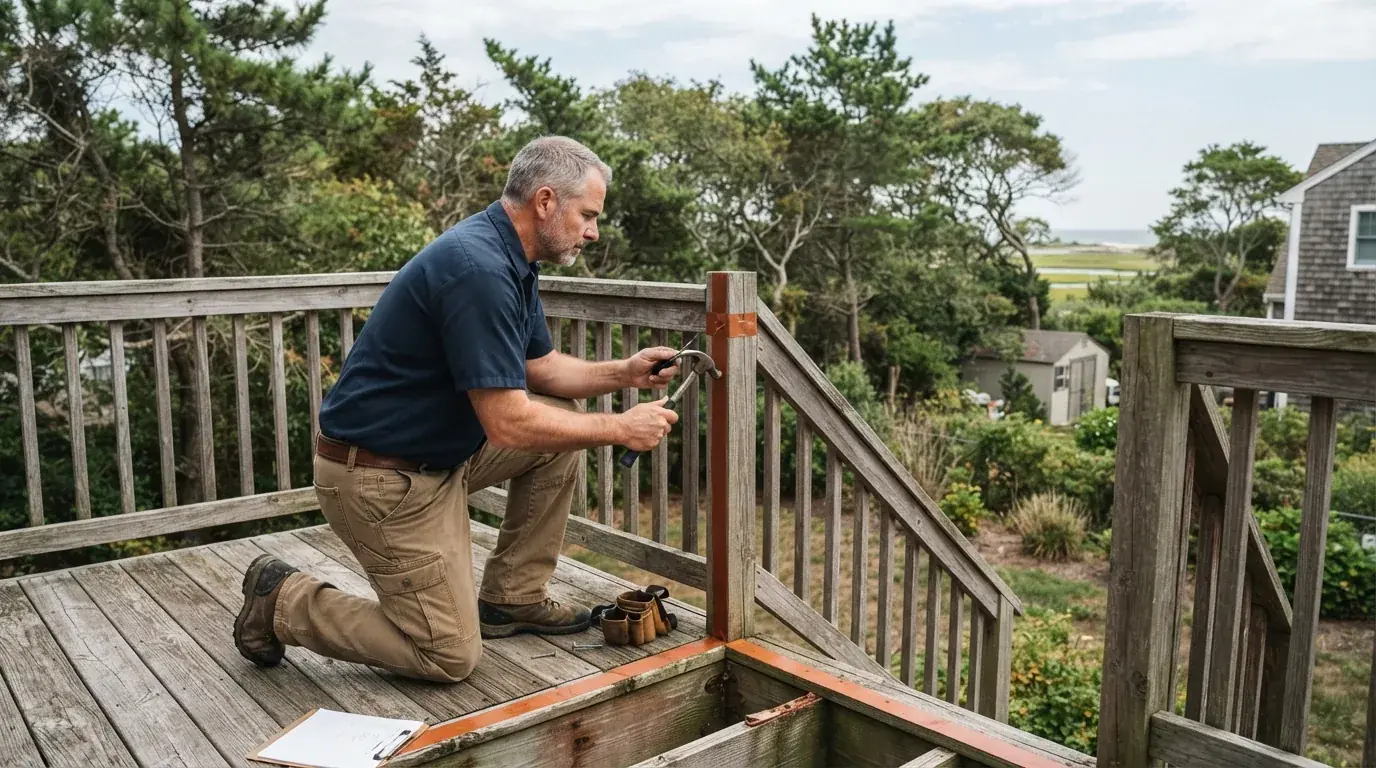
August along the Jersey Shore is deceptively calm. The beaches are crowded, the weather feels settled, and hurricane season feels like someone else’s problem — until a tropical system forms off the Carolinas and tracks north with 48 hours of warning. For Monmouth County homeowners with a deck, balcony, or raised porch, that narrow window is exactly why late summer is the right time for a thorough inspection.
A professional deck inspection in Monmouth County costs $150 to $400 depending on size and complexity, while common pre-storm repairs — board replacement, railing tightening, flashing repair — typically run $200 to $2,500. Catching a rotted joist or corroded ledger board now prevents a catastrophic failure when 60 mph gusts hit your backyard in September.
Key Takeaways
- Inspect your deck every August before peak hurricane season — coastal salt air and winter freeze-thaw accelerate structural decay.
- Professional deck inspections in Monmouth County cost $150–$400 for a thorough structural assessment.
- Common pre-storm repairs run $200–$2,500 depending on whether you need board replacement, railing work, or structural fixes.
- The ledger board connection — where the deck attaches to the house — is the single most critical inspection point.
- Loose railings, corroded fasteners, and soft wood are the top red flags on coastal decks in West Long Branch, Long Branch, and surrounding shore towns.
Why August Is the Right Month for a Deck Inspection
Hurricane season runs June 1 through November 30, but the statistical peak for Atlantic storms falls between mid-August and late October. The National Weather Service tracks an average of 14 named storms per season, with the majority of significant Northeast impacts occurring after August 15.
By August, your deck has already endured:
- Six months of salt air exposure from onshore breezes carrying ocean spray inland
- Spring and early summer humidity that drives moisture into end-grain and fastener holes
- UV degradation that breaks down stain, sealant, and the lignin in wood fibers
- Thermal expansion and contraction from temperature swings between 30°F winter nights and 95°F summer afternoons
Waiting until a storm is named on the Weather Channel means competing with every other homeowner for contractor availability — and paying rush rates for emergency deck repair when a proactive fix in August would have cost a fraction.
Deck Inspection Checklist for Coastal Monmouth County Homes
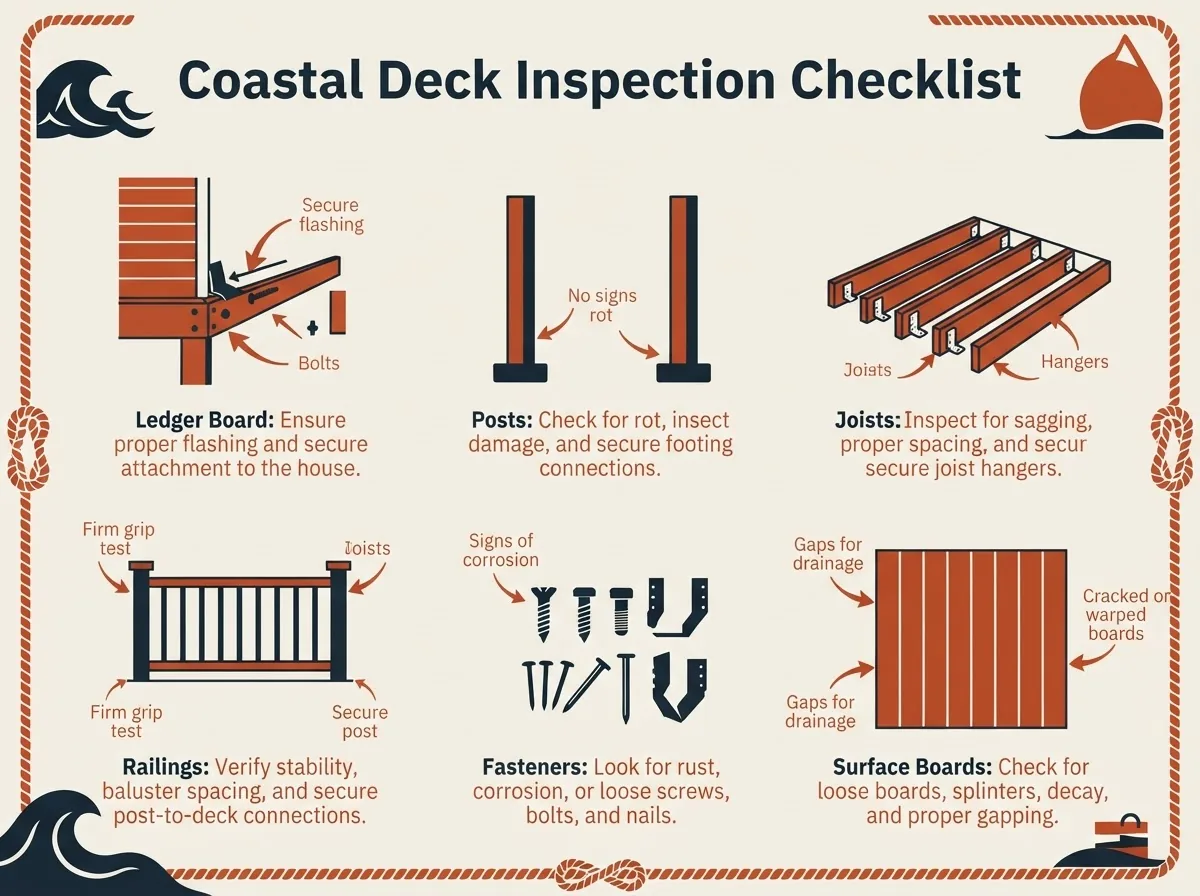
Walk your deck systematically. Bring a flathead screwdriver, a tape measure, and a level. Probe suspicious areas firmly — soft wood gives way under pressure.
Ledger Board and House Connection
The ledger board is the horizontal board bolted to your home’s rim joist. It carries the entire load of the deck framing. On coastal homes in West Long Branch, Deal, and Monmouth Beach, this is where we find the most serious problems.
What to check:
- Is the ledger bolted (not nailed) through the siding into the rim joist with lag screws or through-bolts?
- Is there flashing between the ledger and the house to prevent water intrusion?
- Are any bolts rusted, loose, or pulling out of the wood?
- Is the siding above the ledger stained, indicating water has been getting behind the board?
A failed ledger connection is the leading cause of deck collapses nationwide. Repairing or replacing a ledger with proper flashing runs $500–$1,500 depending on access and siding type.
Support Posts and Footings
What to check:
- Are posts plumb (vertically straight)?
- Is there wood-to-soil contact — posts should sit on concrete footings or metal post bases, never directly in dirt?
- Are post bases corroded? Galvanized hardware in salt air often shows rust within 5–8 years
- Are footings cracked, heaved, or tilting?
Post replacement with a new footing costs $200–$500 per post. Catching a leaning post early prevents a chain reaction that pulls the entire structure out of level.
Joists, Beams, and Hardware
What to check:
- Probe joist ends where they meet the ledger and beam — this is where moisture collects
- Look for sagging between joists (indicates undersized lumber or rot)
- Check hurricane ties and joist hangers for corrosion and missing nails
- Inspect the beam-to-post connections for splitting or uplift damage
Joist sistering (bolting a new joist alongside a damaged one) costs $150–$400 per joist. Full joist replacement costs more but is necessary when rot exceeds 30% of the cross-section.
Decking Boards
What to check:
- Walk the surface and note any bounce, spring, or movement
- Look for cupping, splitting, or boards pulling away from fasteners
- Probe soft spots — especially near the house wall and at board ends
- Check for popped nails or screws and protruding splinters
Individual board replacement runs $15–$40 per board installed. If more than 20% of boards show damage, a full redecking project at $15–$35 per square foot may be more cost-effective.
Railings and Stairs
What to check:
- Push firmly on every railing section — any movement beyond 1/2 inch is a problem
- Inspect baluster spacing (code requires gaps no wider than 4 inches)
- Check stair stringers for rot, especially at the bottom tread contact point
- Verify handrail height (34–38 inches) and graspability
Railing repair or replacement costs $30–$75 per linear foot depending on material. Given that railings are the primary fall protection, this is not a repair to defer.
Coastal Conditions That Accelerate Deck Damage
Monmouth County decks face environmental stress that inland decks in Hunterdon or Somerset counties never experience.
Salt air corrosion. Ocean spray carries salt particles that settle on every metal surface — screws, nails, joist hangers, post bases, and railing brackets. Standard galvanized hardware that lasts 20 years inland may show significant rust in 8–10 years at the shore. Stainless steel or hot-dipped galvanized fasteners are worth the upgrade on any coastal deck.
UV exposure. Decks with southern or western exposure bake in direct sun from April through October. UV breaks down wood lignin and stain binders, turning surfaces gray and opening the grain to moisture. Decks without shade structures need restaining every 2–3 years in this climate.
Wind uplift. Open deck designs catch wind like a sail. Uplift forces pull on the ledger connection, post bases, and railing attachments. A deck that feels solid on a calm day can flex alarmingly in a 50 mph gust if connections have loosened over time.
Sand and grit abrasion. Homes near the beach track sand onto deck surfaces. Foot traffic grinds abrasive particles into the wood finish, accelerating wear. Regular sweeping and periodic washing extend the life of your stain or sealant.
Deck Inspection Cost vs. Storm Damage Cost
| Scenario | Proactive Cost | After-Storm Cost |
|---|---|---|
| Professional inspection | $150–$400 | N/A — damage already done |
| Board replacement (5–10 boards) | $200–$600 | $500–$1,500 + structural assessment |
| Ledger repair with flashing | $500–$1,500 | $2,000–$5,000+ if collapse damages siding |
| Railing replacement (20 linear feet) | $600–$1,500 | Liability exposure if someone falls |
| Full deck rebuild | $8,000–$20,000+ | Same, plus emergency scheduling premium |
The math is straightforward: a $300 inspection and a $800 repair in August beats a $3,000 emergency rebuild in September — plus the risk of injury if the deck fails while someone is on it.
Wood vs. Composite: Different Inspection Priorities
Pressure-treated wood decks need the most attention. Check for rot at every connection point, probe board ends, and inspect the underside if accessible. Wood decks in Monmouth County should be restained or sealed every 2–3 years. If water absorbs instead of beading on the surface, the protective finish has failed.
Composite decks resist rot but are not maintenance-free. Inspect for sagging between joists (often caused by undersized framing, not board failure), check for mold or mildew in shaded areas, and verify that hidden fastener clips have not corroded or popped loose. Composite board replacement runs $20–$50 per board — more than wood but without the rot risk.
PVC and capped composite perform best in coastal conditions but still require structural inspection of the framing underneath. The decking surface may look perfect while a joist underneath has been rotting for two years.
DIY Inspection vs. Professional Assessment
A homeowner walk-through catches obvious problems — loose railings, split boards, visible rot. A professional inspection goes deeper:
| What You Can Check Yourself | What a Pro Should Assess |
|---|---|
| Loose railings and wobbly posts | Ledger bolt count, size, and spacing |
| Soft spots in decking boards | Joist span calculations and load capacity |
| Popped fasteners and splinters | Hurricane tie and joist hanger integrity |
| Surface stain wear (water bead test) | Footing depth and frost-line compliance |
| Visible mold or mildew | Code compliance for railing height and baluster spacing |
If your deck is more than 15 years old, elevated more than 4 feet, or attached to your home, a professional inspection before storm season is worth the $150–$400 investment.
Pre-Storm Deck Prep: Quick Actions for August
Beyond the structural inspection, these steps take an afternoon and reduce storm damage risk:
- Clear the deck surface. Store furniture, planters, grills, and loose items in the garage or shed. A 40 mph gust turns a patio chair into a projectile.
- Trim overhanging branches. Tree limbs within 10 feet of the deck can snap and crash through railing sections during high winds.
- Clean gutters above the deck. Overflowing gutters dump water directly onto the ledger board and deck surface, accelerating rot at the most vulnerable connection point.
- Tighten all visible fasteners. A cordless drill and an hour of your time can secure dozens of loose screws before they work free in wind vibration.
- Apply fresh sealant to any cracks or end-grain openings if you are within your regular maintenance cycle.
For structural repairs — ledger work, joist replacement, post resets — hire a professional through our deck repair services. Storm prep is not the time for learning carpentry on a load-bearing connection.
How Trusty Monmouth County Handyman Can Help
The Trusty Monmouth County Handyman has inspected and repaired coastal decks across Monmouth County for more than 15 years. We know what salt air does to a ledger board in West Long Branch, what a nor’easter does to railing connections in Sea Bright, and what August humidity does to joist ends in Rumson.
Our deck repair team handles board replacement, railing repair, structural reinforcement, staining, and full restoration. We also coordinate with our carpentry services for custom railing builds and structural framing work.
We are fully licensed and insured, and we offer free estimates on deck projects over $200. Do not wait for a named storm to find out your deck has a problem.
Call (848) 272-9900 or request an estimate to schedule your pre-storm deck inspection.
Frequently Asked Questions
When should I inspect my deck in Monmouth County?
Inspect your deck every August, before peak hurricane season. Also inspect after any major storm that brings sustained winds over 40 mph or significant flooding.
How much does a deck inspection cost in NJ?
A professional deck inspection in Monmouth County costs $150–$400 depending on deck size, height, and accessibility. This is a fraction of the cost of storm-related structural failure.
What is the most common deck failure point on coastal homes?
The ledger board connection where the deck attaches to the house. Corroded bolts, missing flashing, and rot at this junction are the leading causes of deck collapses — especially in salt air environments.
How often should I restain a wood deck at the Jersey Shore?
Every 2–3 years in Monmouth County’s coastal climate. Perform the water bead test: splash water on the boards. If it soaks in rather than beading up, it is time to clean and restain.
Can I use my deck during hurricane season if it has minor damage?
Minor cosmetic issues like faded stain are fine. Any structural concern — soft wood, loose railings, wobbly posts, or a moving ledger — should be repaired before the deck carries any load, especially during storm season when wind forces multiply stress on weak connections.