
Key Takeaways
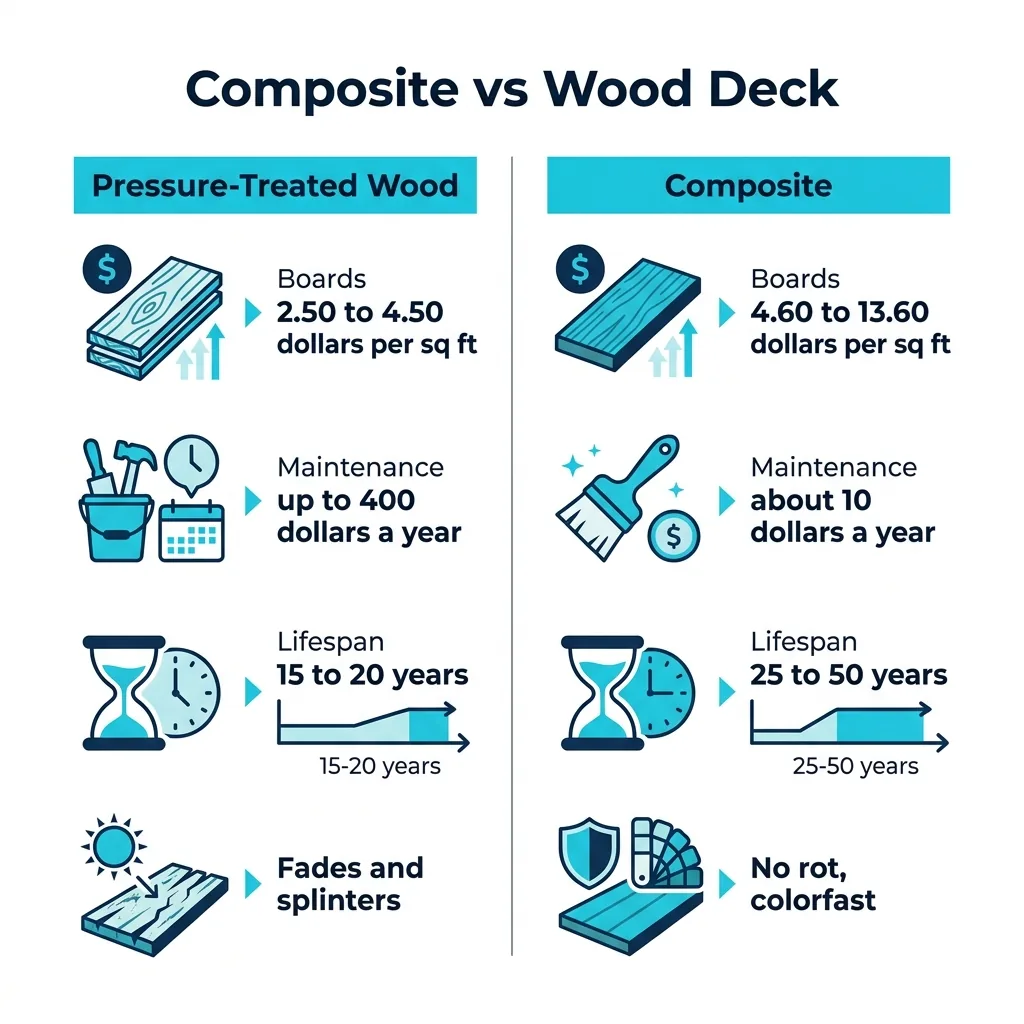
- Wood decking costs less upfront: pressure-treated pine runs $2.50 to $4.50 per square foot for the boards alone. Composite ranges from $4.60 to $13.60 per square foot.
- Wood maintenance costs up to $400 per year in stains, sealants, and repairs. Composite runs about $10 per year.
- Composite decking typically lasts 25 to 50 years. Pressure-treated wood lasts 15 to 20 years with consistent upkeep, and less near the shore.
- Near the Jersey Shore, salt air, humidity, and freeze-thaw cycles accelerate wood rot and speed up the maintenance cycle significantly.
- National installation cost for basic wood decking starts at $11.51 to $14.79 per square foot installed, before structural framing.
For most Monmouth County homeowners, composite wins long-term. Wood costs less to buy. Composite costs less to own. Here’s the full breakdown so you can decide which trade-off fits your situation.
Side-by-Side: The Numbers That Matter
This comparison uses pressure-treated pine as the wood baseline, since that’s what most Monmouth County homeowners choose for cost reasons. Cedar and redwood cost more upfront but perform somewhat better.
| Factor | Pressure-Treated Wood | Composite |
|---|---|---|
| Material cost per sq ft (boards only) | $2.50 to $4.50 | $4.60 to $13.60 |
| Installed cost per sq ft (labor + boards) | $11.51 to $14.79 | Higher (varies by brand) |
| Annual maintenance cost | Up to $400 | About $10 |
| Lifespan (with upkeep) | 15 to 20 years | 25 to 50 years |
| Splinter risk | Yes | No |
| Rot/insect risk | Yes | No |
| Fade over time | Yes (grays within 1 to 2 seasons) | Minimal (colorfast) |
| Warranty | None standard | 25 to 50 years (residential) |
Sources: Trex Composite vs. Wood Comparison, Homewyse Wood Decking Install Cost
When Wood Makes More Sense
Wood wins in specific situations. It’s not the wrong choice for everyone.
Tight upfront budget. If you need a functional deck this season and cash is limited, pressure-treated pine gets you there. The boards cost half of what mid-range composite does. If you’re selling the house in two to three years and want to add outdoor living space to improve buyer appeal, a clean wood deck can make sense. You get the value-add without committing to a 25-year material.
Short project horizon. Not every homeowner is planning to stay 20 years. A well-built pressure-treated deck that looks clean at sale time does its job. Our post on essential pre-market home repairs to boost buyer appeal covers exactly this scenario.
Authentic look matters. Some homeowners genuinely prefer real wood. Composite has improved dramatically and now mimics wood grain convincingly, but nothing replicates the actual texture and smell of cedar or redwood. If authenticity matters to you and you’re willing to do the upkeep, wood is a legitimate choice.
One honest caveat: most homeowners who choose wood because of the upfront savings tell us later that the annual maintenance took more time and money than they expected, especially after a few harsh NJ winters.
Why Composite Usually Wins Near the Shore
The Jersey Shore puts wood decks through more stress than most places in the country. Salt air accelerates oxidation and rot. The humidity is consistently high from late spring through summer. Freeze-thaw cycles from November through March drive moisture into wood grain and expand it, cracking boards and lifting fasteners.
A pressure-treated deck in Ocean Township or Sea Bright looks aged in three to four years if it’s not maintained aggressively. By year seven or eight, it’s common to see significant board warping, joist rot where water pools, and fasteners that have started to push through the surface.
Composite handles all of that without complaint. It doesn’t absorb moisture. Salt air doesn’t eat it. It doesn’t need a stain before the first nor’easter in November. We’ve seen deck restoration projects in this area where homeowners have spent several thousand dollars restoring a wood deck that was only 10 to 12 years old because the maintenance had been deferred.
That’s the real cost of wood near the water.
The Long-Term Math
Here’s how the numbers actually stack up over 25 years for a 400 square-foot deck.
Pressure-treated wood deck:
- Initial materials and installation: roughly $4,600 to $5,900 (using $11.51 to $14.79 per sq ft installed)
- Annual maintenance (staining, sealing, minor repairs): up to $400 per year
- 25-year maintenance total: up to $10,000
- Likely replacement at year 15 to 20, so potentially a second deck build in that window
- Total 25-year cost: $14,600 to $25,000 or more, depending on whether replacement happens
Mid-range composite deck:
- Initial materials and installation: higher upfront, typically 30% to 50% more than wood for a comparable size
- Annual maintenance: about $10 for cleaning supplies
- 25-year maintenance total: about $250
- No replacement expected within 25-year window (backed by manufacturer warranty, with composite lifespan typically 25 years or more)
- Total 25-year cost: more predictable, lower ceiling
The composite buyer pays more at the start. The wood buyer pays repeatedly for 25 years, often reaching a higher total with less to show for it structurally.
What to Actually Check Before You Decide
Before choosing a material, answer these questions honestly.
How long are you staying? If you’re in the house for fewer than five years, wood makes more financial sense. If you’re staying 10 or more years, composite pays off.
How close are you to the water? A home on a lake or within a mile of the ocean shore is different from a home in a landlocked part of Monmouth County. The closer you are to salt air, the stronger the case for composite.
Do you actually want to maintain it? No judgment here. Some homeowners genuinely enjoy the annual stain-and-seal ritual. Most don’t. Composite eliminates the task entirely.
What’s your framing made of? Composite boards still need a structural frame underneath. That frame should be pressure-treated lumber, regardless of what you put on top. A composite surface over a rotting frame is still a problem in 10 years.
We handle deck repair and restoration across Monmouth County, and we can give you a straight assessment of what your specific yard, slope, and proximity to water actually calls for. Call us or visit our home repair services page for more on what we cover.
Ready to get real numbers for your specific deck project? Call (848) 272-9900 for a free, no-obligation estimate. We’re fully licensed and insured, and we give you upfront pricing before any work starts.
Frequently Asked Questions
1. What are the main disadvantages of composite decking?
Composite decking costs more upfront than pressure-treated wood, and lower-end composite boards can absorb heat in direct sun, making the surface uncomfortable to walk on barefoot during hot NJ summers. Some composite products can also stain from grease or tannins if spills aren’t cleaned quickly. That said, quality composites from major brands have improved substantially, and most of these drawbacks are minor compared to wood’s maintenance demands.
2. How much would a 20×20 composite deck cost?
A 20×20 deck is 400 square feet. Material and installation costs for composite at mid-range pricing typically run 30% to 50% more than comparable wood construction. Using wood as the baseline ($11.51 to $14.79 per sq ft installed), a rough estimate for composite installation starts at $15,000 to $22,000 or more for a 400 square-foot deck, depending on the brand, edge trim, fasteners, and local labor rates.
3. How long does a wood deck last in New Jersey?
With consistent maintenance (annual staining and sealing), a pressure-treated wood deck in Monmouth County lasts 15 to 20 years. Near the shore, where salt air, humidity, and freeze-thaw cycles are more intense, the realistic lifespan without aggressive maintenance is closer to 10 to 12 years before significant repairs are needed. Composite decking typically lasts 25 to 50 years in the same climate.