In this article:
- Step-by-step instructions for power washing siding, brick, and trim safely
- Real cost data on pressure washing a house, from Homewyse’s 2026 cost calculator
- The electrical shock hazards the Consumer Product Safety Commission has warned homeowners about
- The right PSI setting for each type of siding, so you don’t strip paint or crack vinyl
- When a DIY wash turns into a job for a licensed pro
Key Takeaways
- Pressure washing a house runs $0.45 to $0.56 per square foot when done professionally, and most homeowners pay $250 to $700 for a full exterior wash.
- The CPSC has warned that pressure washers can cause fatal electrical shock if the power cord or connections get wet, and recommends a grounded outlet with GFCI protection.
- Vinyl siding, brick, and painted wood each need a different PSI setting and nozzle angle. Using the wrong one is the most common way DIYers damage their own siding.
- Salt air near the Jersey Shore speeds up mildew and grime buildup, so West Long Branch homes often need washing more often than homes further inland.
- If your gutters, second story, or any electrical fixtures are in the wash zone, that’s usually the point where hiring a pro makes sense.
A power washer looks simple: point, pull the trigger, watch the grime disappear. In practice, the wrong pressure or the wrong angle can strip paint, force water behind siding, or send you to the ER with a laceration from the spray tip. This guide walks through how to do it right, what it should cost, and where the line is between a Saturday project and a call to a licensed crew.
What You Need Before You Start
A basic residential pressure washer produces somewhere between 1,300 and 2,800 PSI (pounds per square inch), which is plenty of force to remove years of grime, but also plenty of force to hurt you or your siding if you’re not careful. Before you start, gather:
- A pressure washer rated for home exterior use, not a commercial unit
- A fan-tip nozzle (25 or 40 degrees) rather than a narrow “turbo” or zero-degree tip
- A ladder rated for the height you’re working at, with a helper holding it steady
- Exterior-safe cleaning solution if you’re dealing with mildew or algae
- Safety glasses and closed-toe, slip-resistant shoes
Skip the narrow zero-degree nozzle entirely for house washing. It’s built for concrete and can cut into wood siding or shatter old caulking in seconds.
Key takeaway: The nozzle you choose matters more than the machine you rent. A fan-tip nozzle at the right PSI cleans just as well as a narrow tip, without the risk of gouging siding or forcing water behind panels.
Step-by-Step: How to Power Wash Your House Exterior
- Walk the perimeter first. Look for loose siding, peeling paint, cracked caulk around windows, or exposed electrical outlets. Mark or avoid these spots; high-pressure water will make small problems worse.
- Cover outdoor outlets, light fixtures, and vents with plastic and tape. Close all windows and doors.
- Start low pressure, high distance. Begin about 3 to 4 feet from the surface and test a small, hidden area before committing to the full wall.
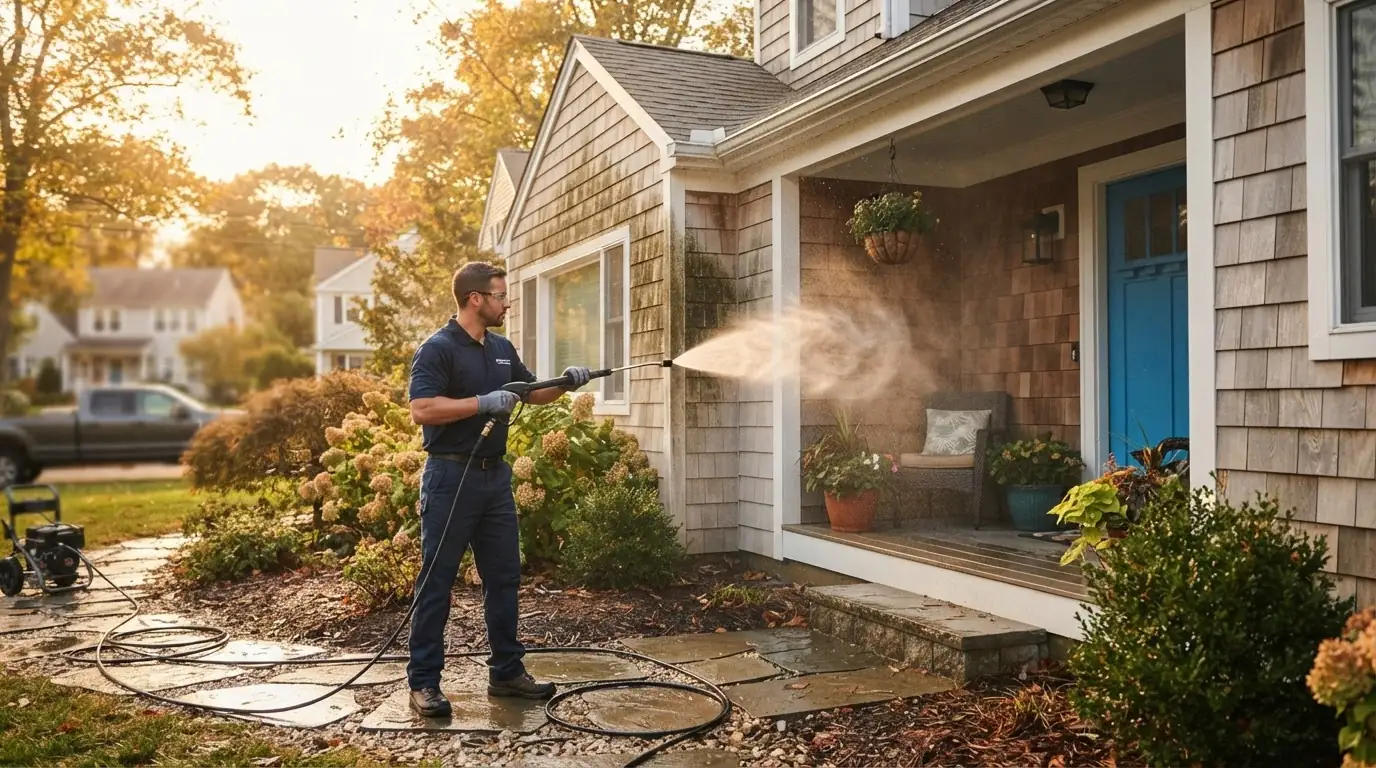
- Work top to bottom in overlapping passes, holding the nozzle at a slight downward angle so water sheds off the siding instead of driving up under it.
- Rinse thoroughly after any soap or cleaning solution, working from the top down again so runoff carries dirt away rather than re-depositing it lower on the wall.
- Let everything dry for at least a day before caulking, painting, or reinstalling anything you removed.
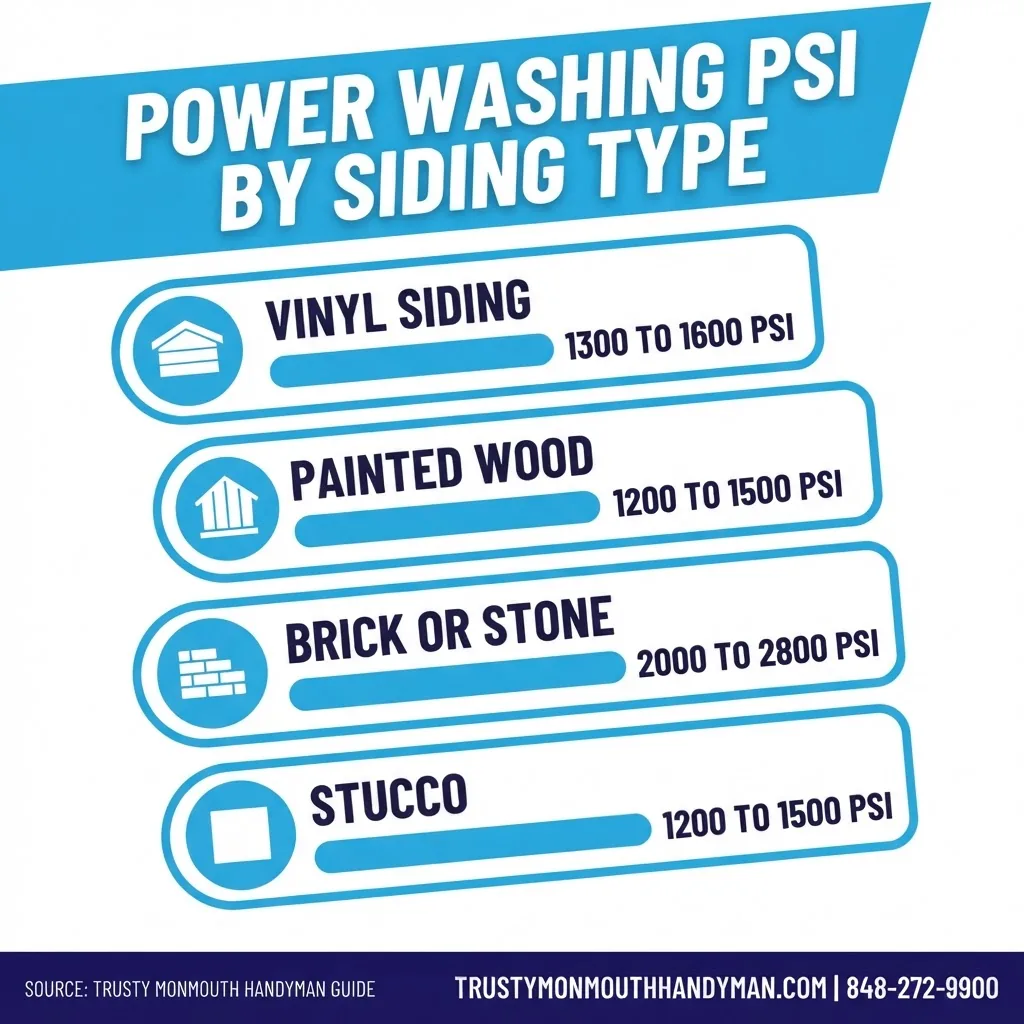
| Siding Type | Recommended PSI | Nozzle Tip | Notes |
|---|---|---|---|
| Vinyl siding | 1,300–1,600 PSI | 40-degree fan | Too much pressure forces water behind panels |
| Painted wood | 1,200–1,500 PSI | 25 or 40-degree fan | Test an inconspicuous spot first for peeling paint |
| Brick or stone | 2,000–2,800 PSI | 15 or 25-degree fan | More forgiving, but mortar joints can erode over time |
| Stucco | 1,200–1,500 PSI | 40-degree fan | Low pressure only; stucco chips easily |
| Composite/fiber cement | 1,500–2,000 PSI | 25-degree fan | Follow manufacturer guidance; some brands void warranty over 3,000 PSI |
What Power Washing Actually Costs
If you’d rather hire it out, professional pressure washing for a house exterior costs $0.45 to $0.56 per square foot as a national average, which works out to roughly $250 to $700 for most single-family homes depending on square footage, number of stories, and how much mildew or algae buildup there is.
Renting a consumer-grade pressure washer for a weekend typically runs less than that, but factor in your time, the risk of siding damage, and the fact that most rental units don’t come with a lesson in nozzle selection. For a home with two stories, heavy staining, or a lot of trim detail, the labor savings from DIY often get eaten up by the extra time it takes to do it safely.
The Safety Risk Most Homeowners Underestimate
Pressure washers combine two hazards that don’t mix well: water and electricity. The Consumer Product Safety Commission has issued warnings about fatal electrical shock risk when a pressure washer’s power cord connections become wet or an internal short develops. Their recommendation is straightforward: always plug into a properly grounded, GFCI-protected outlet, and wear insulated, slip-resistant footwear while operating the machine.
The other hazard is the spray itself. At close range, a pressure washer stream can break skin, which is why keeping distance and using the right nozzle from the start matters as much as the cleaning result. If you’re working from a ladder to reach a second story, you’re now managing a fall risk and an electrical hazard at the same time, which is exactly the kind of task where a second set of trained hands changes the outcome.
Key takeaway: The biggest power washing risk isn’t a scratched deck, it’s a GFCI-protected outlet you skipped or a ladder angle you rushed. Both are avoidable, and both are where most DIY injuries happen.
Why Coastal Homes Need This More Often
West Long Branch and the surrounding shore towns deal with something inland Monmouth County doesn’t see as much: salt air. That extra moisture and salt content in the air speeds up mildew, algae, and grime buildup on siding, especially on north-facing walls that don’t get much direct sun. If your home is within a few miles of the water, an annual wash is often not enough to keep ahead of it.
This is also where power washing connects to a bigger seasonal picture. Homes closer to the water tend to face a wider range of exterior maintenance issues, from moisture intrusion to faster wear on paint and trim, which we cover in more detail in our guide to home repair issues in coastal West Long Branch homes.
When to Call a Pro Instead
Power washing is a reasonable DIY project for a single-story home with straightforward siding and no major repair needs. It stops being a weekend project when any of the following are true:
- You need to reach a second story or steep roofline
- There’s visible rot, loose siding, or failing caulk that pressure could worsen
- You’re washing right before a paint job and need a surface that’s properly clean without damage
- Your electrical panel, meter, or outdoor fixtures sit in the spray zone
If your siding needs more than a wash, whether that’s peeling paint, damaged trim, or caulking that’s failed around windows and doors, our team handles the full range through home repair services in West Long Branch. We also handle wood deck cleaning and staining as part of our deck restoration and staining work, which typically starts with the same kind of controlled pressure wash covered here.
If you’re planning to repaint after washing, it’s worth reading up on what exterior painting costs in Monmouth County first, since a proper wash is step one of any paint job that’s going to last.
Ready for a Professional Wash?
A clean exterior is one of the fastest ways to make a home look cared for, and it protects the siding, trim, and paint underneath it. If a DIY wash feels like more risk than it’s worth, our crew has handled exterior cleaning across Monmouth County for over 25 years, and we treat every home like it’s our own.
Browse our full range of services or get in touch for a free estimate. Call or text (848) 272-9900 and we’ll walk your exterior with you before any water touches your siding.
Frequently Asked Questions
1. How often should I power wash my house exterior?
Most Monmouth County homes benefit from an annual wash. Homes near the shore, where salt air speeds up mildew and algae growth, often need it more frequently, sometimes twice a year on north-facing walls.
2. What PSI is safe for vinyl siding?
Stay in the 1,300 to 1,600 PSI range with a wide fan-tip nozzle. Anything higher risks forcing water behind the panels or cracking the vinyl itself.
3. Is power washing dangerous?
It can be. The CPSC has warned about fatal shock risk if power connections get wet, and the spray itself can cause injury at close range. Grounded, GFCI-protected outlets and proper nozzle distance reduce the risk significantly.
4. How much does professional power washing cost?
Professional pressure washing averages $0.45 to $0.56 per square foot, which typically works out to $250 to $700 for a full single-family home exterior.