

In this article:
- A step-by-step process for clearing gutters and downspouts safely
- What gutter cleaning costs if you’d rather hire it out, per Homewyse’s 2026 data
- Why clogged gutters near the shore become a mosquito and standing-water problem, per the EPA
- How proper downspout drainage protects your foundation, per EPA guidance on downspouts
- Warning signs your gutters need more than a cleaning
Key Takeaways
- Gutter cleaning costs $1.10 to $1.35 per linear foot for ground-level gutters up to 10 feet high; higher gutters and steep roofs typically cost more due to added labor and equipment.
- Clean gutters twice a year at minimum, in spring and again before hurricane season ramps up in late summer.
- Clogged gutters that hold standing water are a documented mosquito breeding risk, and the EPA links standing water to diseases like West Nile virus.
- Downspouts need to move water away from your foundation, not just off the roof. The EPA recommends directing downspout water toward a lawn, garden, or rain barrel rather than a paved surface close to the house.
- Overflowing gutters during a summer storm are one of the most common causes of basement leaks and fascia rot we see across Monmouth County.
Summer storms in Monmouth County don’t announce themselves gently. A fast-moving thunderstorm can dump an inch of rain in under an hour, and if your gutters are packed with spring debris, that water has nowhere to go but over the edge, down your siding, and straight toward your foundation. Cleaning your gutters before storm season isn’t a chore you can put off. Here’s how to do it right.
Why Gutter Cleaning Matters More in Summer
Gutters do one job: move water off your roof and away from your house. When they’re clogged with leaves, seed pods, and roof grit, that water backs up instead of draining. It spills over the gutter’s edge, runs down your siding, and pools at the base of your foundation, exactly where you don’t want standing water during a heavy summer downpour.
Clogged gutters also create a second problem that’s easy to overlook: standing water is a mosquito breeding ground. The EPA identifies clogged, water-holding debris as one of the more common mosquito breeding sites around a home, and mosquitoes are capable of transmitting diseases including West Nile virus. A gutter full of wet leaves after a spring rain is functionally a small stagnant pond sitting right above your front door.
Key takeaway: A clogged gutter isn’t just a water problem, it’s a pest problem. Standing water in gutters checks every box the EPA lists as a mosquito breeding risk.
Step-by-Step: How to Clean Your Gutters
- Set up a sturdy ladder on level ground, with someone spotting you if possible. Never lean a ladder against the gutter itself; it can bend or pull loose under your weight.
- Scoop out large debris by hand or with a plastic gutter scoop, working away from the nearest downspout so you’re not pushing material further into it.
- Flush the gutter with a garden hose, starting at the end furthest from the downspout and working toward it, to confirm water flows freely.
- Check the downspout for clogs. If water backs up instead of draining, a plumber’s snake or a strong blast of water from the bottom up can usually clear it.
- Inspect gutter hangers and seams while you’re up there. Loose brackets or separated seams are easy to spot now and much cheaper to fix before a storm tests them.
- Confirm the downspout discharge point directs water at least several feet away from your foundation, ideally toward a lawn or garden bed rather than a driveway or walkway.
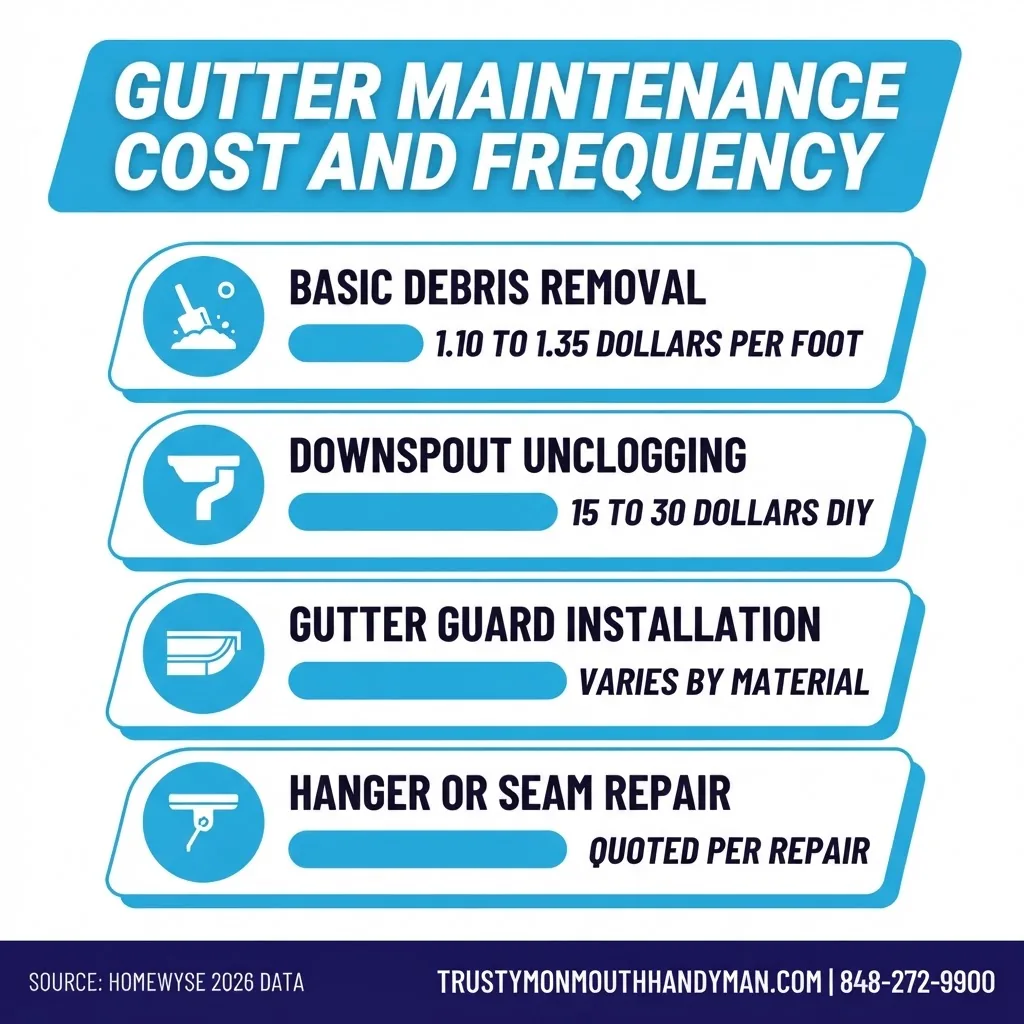
| Gutter Maintenance Task | DIY Cost | Professional Cost | Frequency |
|---|---|---|---|
| Basic debris removal (ground-level) | Ladder rental + time | $1.10–$1.35 per linear foot | 2x/year minimum |
| Downspout unclogging | Plumber’s snake ($15–$30) | Usually bundled with cleaning | As needed |
| Gutter guard installation | Varies by material | Quoted per project | One-time |
| Hanger/seam repair | Hardware store parts | Quoted per repair | As found |
The Downspout Piece Homeowners Skip
Most people stop at cleaning the gutter itself and forget the downspout is doing half the work. If your downspout dumps water directly onto a driveway or straight down next to your foundation, you’re trading one problem for another. The EPA specifically recommends redirecting downspout discharge away from paved surfaces and toward a lawn, garden bed, or rain barrel, both to reduce runoff into storm drains and to keep water from pooling against your house.
This matters even more in coastal Monmouth County towns, where sandy, moisture-retentive soil already holds water longer than inland clay-based soil. A downspout emptying six inches from your foundation, combined with sandy soil, is a recipe for a damp crawl space or a wet basement after the next big storm. If foundation moisture is already a concern at your house, it’s worth pairing gutter maintenance with a look at your sump pump setup, which handles the water that does make it through.
Signs Your Gutters Need More Than a Cleaning
Sometimes a good scoop-and-flush isn’t enough. Watch for:
- Sagging sections that pull away from the fascia board, a sign the hangers have failed
- Visible rust, cracks, or seam separation, which cleaning won’t fix
- Water stains on siding below the gutter line, suggesting it’s been overflowing for a while
- Fascia board that feels soft or shows rot, often caused by long-term overflow
These are the same warning signs we cover in our guide on the most common causes of roof leaks, since a failing gutter system is one of the top contributors to slow, hard-to-spot roof leaks. If ice dams were a problem at your house last winter, it’s also worth reading our guide on preventing ice dams, since clogged gutters are frequently part of that cause chain too.
Key takeaway: If cleaning doesn’t restore normal drainage, the problem is likely structural, sagging hangers, separated seams, or fascia rot, and that’s a repair job, not a maintenance job.
When to Call a Pro
A single-story home with easy roof access is a reasonable DIY gutter cleaning project for most homeowners. It’s worth calling a professional when:
- You’d need a ladder taller than what you have safely rated for your home’s height
- Gutters are sagging, separated, or show signs of structural failure
- You’re not confident diagnosing whether a downspout clog is debris or a deeper drainage issue
- You want the whole exterior addressed at once, including gutters, fascia, and any related coastal moisture issues
Get Your Gutters Storm-Ready
Waiting until the first big summer storm to find out your gutters can’t keep up is an expensive way to learn a lesson. Our team has handled gutter maintenance and repair across Monmouth County for 25+ years, and we treat every home like it’s our own.
Browse our full range of services or get in touch for a free estimate before the next storm rolls in. Call or text (848) 272-9900.

FAQs:
1. How often should I clean my gutters?
At least twice a year, once in spring after trees finish shedding seed pods and buds, and again in late summer before hurricane season peaks, so your gutters can handle heavy storm runoff.
2. How much does professional gutter cleaning cost?
Ground-level gutter cleaning runs $1.10 to $1.35 per linear foot on average. Steeper roofs or gutters higher than 10 feet typically cost more due to added equipment and labor.
3. Can clogged gutters really attract mosquitoes?
Yes. The EPA identifies standing water, including debris-clogged gutters, as a common mosquito breeding site, and mosquitoes can transmit diseases like West Nile virus.
4. Where should my downspout drain?
Away from your foundation and away from paved surfaces where possible. The EPA recommends directing downspout water toward a lawn, garden bed, or rain barrel instead of a driveway or walkway close to the house.