In this article:
- 20 distinct paver patio design concepts, from classic running bond to fire pit lounges
- Real cost ranges for paver installation, sourced from Angi’s 2026 cost data
- Why patios have overtaken decks as the top outdoor feature in new homes, per NAHB
- What actually drives paver patio pricing up or down in Monmouth County
- When a DIY patio project turns into a call for a licensed pro
Key Takeaways
- Paver patios typically run $8 to $25 per square foot installed, with most Monmouth County projects landing between $3,000 and $12,000.
- Patios now appear in 63.3% of new single-family homes, overtaking decks for the first time on record.
- A layered paver base (gravel, sand, geotextile fabric) is what keeps a Jersey Shore patio from heaving after freeze-thaw winters.
- Fire pit lounges, multi-level patios, and shell-and-sand coastal designs are the three concepts getting the most requests this year.
- Site prep, drainage, and grading, not the pavers themselves, are usually where a DIY patio project goes wrong.
Picking a paver patio idea is the fun part. Getting it to hold up through a Monmouth County winter is the part that actually matters. This guide walks through 20 design concepts homeowners are asking for in 2026, what they tend to cost, and where a professional install earns its keep.
Why Patios Are Having a Moment
A patio is a paved outdoor living space, built at or near ground level, usually made from pavers, brick, or poured concrete. Unlike a deck, it doesn’t need structural framing or footings that go below the frost line.
That difference matters more than people think. Patios now show up in 63.3% of new single-family homes, while decks have dropped to under 18%. Builders point to lower maintenance and lower material costs as the main drivers.
We see the same shift here in Monmouth County. Homeowners want a space they can use every weekend without staining, sealing, or replacing boards every few years. A well-built paver patio, on a proper gravel and sand base, can outlast a wood deck by decades.
If your yard already has a tired deck, it’s worth comparing the two directly. Our guide on ***composite vs. wood deck cost and lifespan***breaks down the long-term math.
20 Paver Patio Ideas Worth Considering
Here are 20 concepts we’re seeing requested most in Monmouth County backyards this year, grouped by style.
Classic and Timeless Layouts
- Running bond pattern. Rectangular pavers laid in offset rows. Simple, affordable, and forgiving on uneven yards.
- Herringbone weave. A 45- or 90-degree interlocking pattern that resists shifting under heavy foot traffic. Great for driveway-adjacent patios.
- Basketweave brick. Pairs of pavers set perpendicular to each other. Reads as traditional and pairs well with colonial-style Monmouth County homes.
- Circular paver kit. A radial pattern built around a fire pit or fountain as the centerpiece.
- Two-tone border. A contrasting paver color framing the patio edge. Cheap upgrade, big visual payoff.
Fire and Gathering Spaces
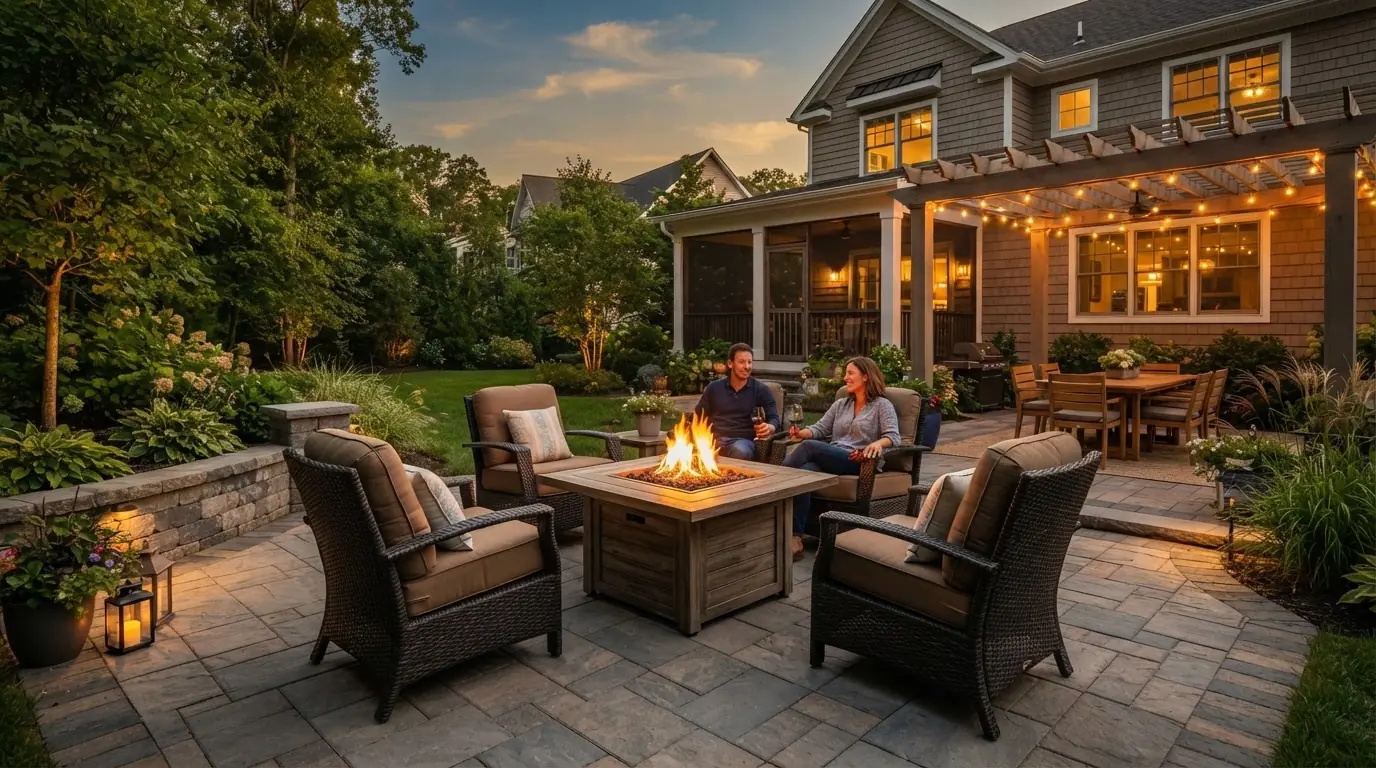
- Fire pit lounge. A circular seating area with built-in paver benches around a stone or metal fire pit. The single most-requested layout this year.
- Outdoor fireplace patio. A raised paver hearth with a chimney structure, paired with an L-shaped seating zone.
- S’mores station. A compact fire pit surrounded by a low paver wall doubling as extra seating for kids.
- Twin fire bowls. Two smaller fire features flanking a dining area, popular for entertaining-focused backyards.
Kitchen and Dining Concepts
- Outdoor kitchen patio. A dedicated paver zone sized for a grill island, counter, and bar seating.
- Pizza oven corner. A stone or paver base built to anchor a wood-fired oven, usually tucked against a side yard.
- Farmhouse dining patio. A rectangular paver slab sized for a long table, framed by planters or a low retaining wall.
- Shaded pergola dining. Pavers laid beneath a pergola structure to define the dining zone from the rest of the yard.
Multi-Level and Layout Concepts
- Split-level patio. Two paver zones at different heights, connected by low steps. Works well on Monmouth County’s sloped lots.
- Wraparound walkway patio. A paver path connecting the driveway, side yard, and back patio into one continuous surface.
- Sunken lounge. A slightly recessed paver seating area, ringed by a low wall, that reads as a natural conversation pit.
- Pool surround patio. A slip-resistant paver deck framing an in-ground pool, sloped for drainage away from the water.
Coastal and Low-Maintenance Concepts
- Shell-and-sand blend border. Local shell aggregate mixed into planting beds around the paver edge, a nod to our shore location.
- Permeable paver system. Gapped pavers over a gravel bed that let rainwater filter through instead of pooling, useful on flood-prone lots near the water.
- Minimalist slab-and-gravel hybrid. Large-format pavers set into a gravel field, cutting material cost while still looking intentional.
Key takeaway: A fire pit lounge or split-level layout costs more upfront than a basic running-bond patio, but both can be phased over two seasons if budget is a concern.
What Drives the Cost of a Paver Patio
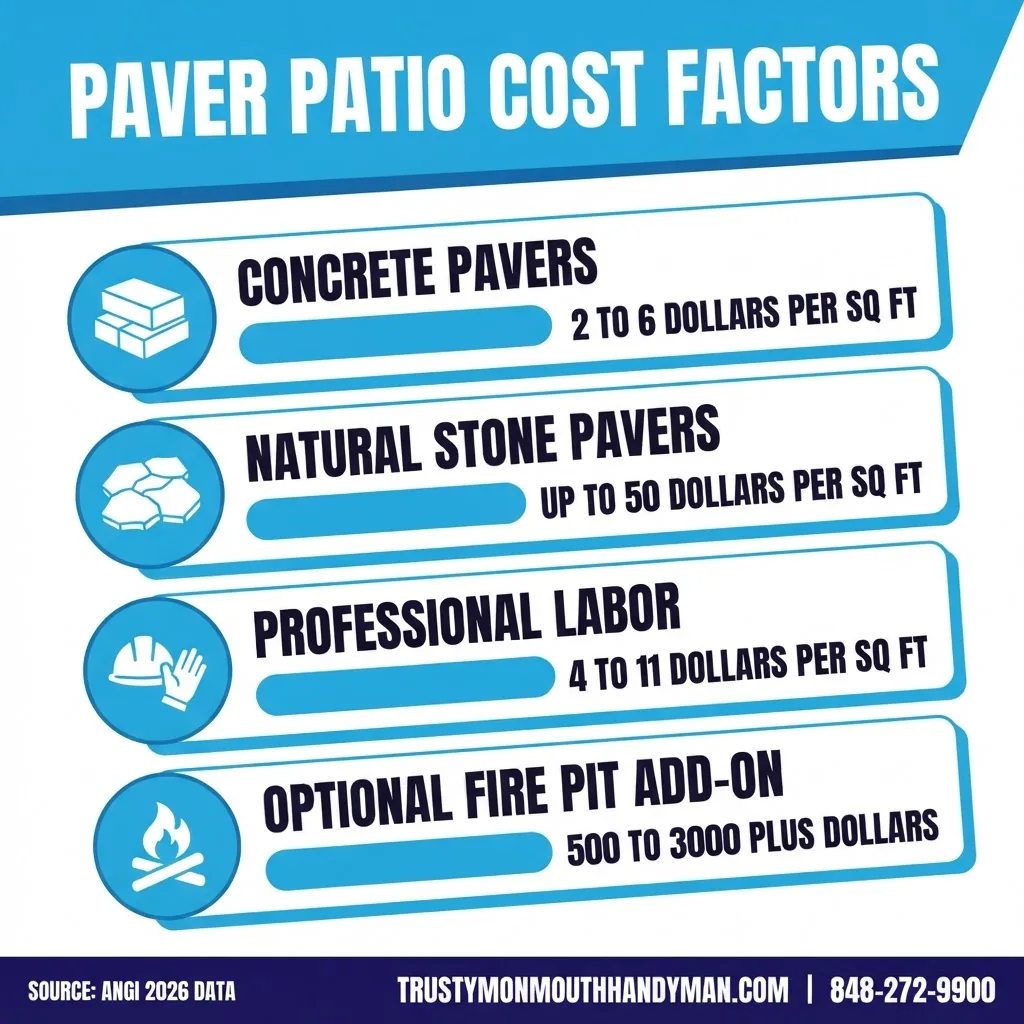
Paver installation typically runs $8 to $25 per square foot, and labor alone accounts for $4 to $11 of that per square foot. A standard 280-square-foot patio averages around $3,800, but the full range stretches from $480 for a tiny DIY slab to over $22,000 for a large, high-end design.
Here’s how the main cost factors break down for a typical Monmouth County project.
| Cost Factor | Typical Range | Notes |
|---|---|---|
| Paver material (concrete) | $2–$6 per sq ft | Most budget-friendly option |
| Paver material (natural stone/flagstone) | Up to $50 per sq ft | High-end, longer lifespan |
| Professional labor | $4–$11 per sq ft, or $50–$80/hour | Includes excavation and base prep |
| Base materials (gravel, sand, fabric) | $0.10–$1 per sq ft | Critical for freeze-thaw stability |
| Sealing (optional) | ~$200 per 1,000 sq ft | Protects against shore-area salt air |
| Fire pit add-on | $500–$3,000+ | Depends on gas line vs. wood-burning |
Site conditions push those numbers around. A yard with poor drainage, tree roots, or a slope needs more excavation and grading before a single paver goes down. That’s the part homeowners tend to underestimate.
Why Base Prep Matters More Than the Pavers Themselves
Here’s a direct definition worth knowing: a paver base is the layered foundation of compacted gravel, sand, and geotextile fabric that sits underneath the visible pavers. It’s what keeps the patio flat and stable.
In Monmouth County, we deal with real freeze-thaw cycles every winter, plus sandy, moisture-retentive soil closer to the shore. Skip a proper base and you’ll see pavers heave, sink, or separate within a year or two. We run into this constantly on patios that were installed as a weekend DIY project without geotextile fabric underneath.
A well-built base, by contrast, drains water away from the surface and stays put through freeze cycles. That’s the difference between a patio that looks good for one summer and one that still looks good in ten.
If your existing patio or walkway already shows separation, cracking, or uneven pavers, it’s often a sign the base failed, not the material. Our team handles patio repairs and rebuilds through home repair services in West Long Branch.
DIY vs. Hiring a Pro
A small, flat, single-tier patio with a simple running bond pattern is realistic for an ambitious DIYer with a weekend or two to spare. Multi-level designs, fire pit installs with gas lines, or anything near a pool’s electrical equipment are a different story.
Grading and drainage planning is the part that trips up most DIY attempts. Get the slope wrong by even half an inch and water pools against your foundation instead of running away from it, which is the same failure mode we cover in our spring storm prep checklist.
If your project involves a fire feature, structural retaining wall, or ties into an existing deck or fence, pairing it with our fence installation cost guide is a good next step for planning a full backyard overhaul.
Ready to Build Your Patio
Picking a design is easy. Getting the base, drainage, and layout right is where a licensed crew earns its keep. Our team has handled patio and hardscape work across Monmouth County for 25+ years, and we treat every yard like it’s our own.
If you’re ready to move from Pinterest board to backyard, browse our full range of services or get in touch for a free estimate. Call or text (848) 272-9900, and we’ll walk the site with you before you spend a dollar on pavers.
Frequently Asked Questions
1. How much does a paver patio actually cost in Monmouth County?
Most homeowners here spend $3,000 to $12,000 depending on size and material. A basic 280-square-foot patio averages around $3,800, while fire pit lounges and multi-level designs run higher because of added labor and features.
2. Are patios better than decks for New Jersey homes?
Patios generally need less upkeep than wood decks and don’t require the same structural footings. That’s part of why 63.3% of new homes now include a patio, compared to under 18% with a deck. Either can work well here; it depends on your yard’s grade and how much maintenance you want to take on.
3. Can I install a paver patio myself?
A small, flat, single-pattern patio is doable for a confident DIYer. Anything with grading challenges, drainage tie-ins, fire features, or multiple levels is worth handing to a pro, since a failed base is the most common reason patios fail early.
4. Do paver patios need sealing?
Sealing isn’t required, but it’s worth considering near the shore, where salt air and moisture speed up wear. Sealing runs about $200 per 1,000 square feet and helps pavers resist staining and shifting.